
A Great Terrible Decision–Part One
My career began with more confidence than common sense.

My CV says I was a “co-founder” of Men’s Wearhouse (MW). True, though I need to point out I was absent from several key co-founding activities. I wasn’t there when George Zimmer dreamed up the idea, nor was I there the day he opened the first store in Houston, along with two friends from college.
I was involved in one way or another from the month the company was founded until I left in early 2002. To paraphrase The Dude (The Big Lebowski), it was all a bit complicated; there were a lotta ins, a lotta outs, and a lotta what-have-yous.
Which is why sometimes it’s just easier to say I was a co-Founder, but if you’re interested in the backstory, here goes:
I actually arrived in Houston in August of ‘73—at the same time as George—but I had a different dream. While George and his friends were opening MW, I was opening the few boxes of my belongings and settling into my small apartment. My dream was to work for an advertising agency. I had fallen in love with advertising—especially the nascent television advertising—in my Junior year at Rutgers. I had also written an Independent Study, “The Psychology of Television Advertising,” in my Senior year.
I was moving from Hazleton, PA, to Houston after working for my father the year following my graduation from Rutgers.
When I look back at this time of my life, I’m both encouraged and amazed at my lack of trepidation and ability to just roll with whatever.
Or was it naiveté?
I’ll let you decide………
The Friday prior to Labor Day weekend (ironically, the same day the first MW opened), I began my search for that advertising job. I hopped into my car and walked into my first ad agency, just down the street from my apartment. I had nothing—no appointment, no resume, no experience. I didn’t even have the famous Independent Study, where students essentially invented their own credentials. I just had me and a lot of chutzpah. The agency was Marcom-Day Advertising, a meager shop with five employees and a handful of clients.
I had found Marcom-Day in the Yellow Pages. *
How did I get the interview? In retrospect, it must have been because the owner, Bob Day, couldn’t believe my gall. What I lacked in brains and experience, I made up for in guts and enthusiasm. Bob resisted hiring me by noting there wasn’t enough business at the agency to warrant another salary. I countered by telling him I’d bring business to the agency. (I had no idea how or when.) No doubt startled by my quick parry, if not intrigued by the prospect, Bob told me if I could bring enough business to the agency, the next time they needed to hire someone, it would be me. We shook hands on the deal, and I was out of there.
I didn’t have a job, but no worries: I had a prospective job. And after visiting a total of ONE agency. I gave myself the rest of the day off and went home, spending the long weekend mentally turning down far superior offers. I just knew the Houston advertising community would soon be fighting over my impressive credentials.
Well……
My interview with Bob was not only the first, it was also my last. Every other agency seemed strangely unimpressed by me. They weren’t the least bit interested, and I was turned down—usually coldly, often rudely. On the few occasions when I did get past the receptionist, my obvious lack of experience was soon unearthed, and I was told I needed “experience.”
“How could I get experience if no one would hire me?” I kept saying to myself.
Yet I didn’t let the thought demoralize me. I kept plowing ahead, knowing deep down inside, everything was going to work out.
In retrospect, pretty amazing. What was going on in my head back then? Apparently, when you’re 22, certainty requires very little supporting evidence.
Unfortunately, after three stinging weeks of sweaty rejections as I drove around in my unairconditioned Citroën in Houston’s 90-degree heat and oppressive humidity, I had to face reality. I was running out of money and had to look for a real job.
Although I believed advertising was still my calling, Bob Day was not. I just needed a job—any job.
The calling would have to wait.
I soon found a job. I became an Account Executive selling display-advertising space in an all-advertising, free weekly circular called the Greensheet. (Think Craigslist, but a paper version.) My job was to sell display ad space. When I was hired, I had a list of current customers—enough so my commission income was livable by itself.
I had the perfect setup: I spent mornings on the phone making calls to current customers; in the afternoons, I scoured the streets looking for new Greensheet customers—as well as looking for clients for Marcom-Day. The former wasn’t nearly as important to me as the latter. I figured anyone who was crazy enough to buy an ad in the Greensheet might also need the expertise of an advertising agency like Marcom-Day.
A few weeks later, as I was driving around town making cold calls, I drove past a shopping center with several retail stores and a dilapidated yet well-known steakhouse. In the middle of the center was a store with a crude, hand-painted black-and-white wooden sign precariously attached to the roof. The sign read “The Men’s Wearhouse.” It looked like an interesting prospect. I walked in, discussed the Greensheet with Harry Levy, one of George Zimmer’s original partners, and sold him a quarter-page ad.
A few days later, I returned with a sample of the ad and met the owner. His name was George. He and I became fast friends, bonding over our shared liberal college experience, our political views, and our Jewish heritage.
And I had my first client for Marcom-Day Advertising. MW’s advertising needed a lot of help. Besides the Greensheet, MW was buying advertising across every conceivable medium, with little consistency and no clear message. I introduced George to Drew Cherner, who would become Marcom-Day’s Account Executive for MW.
The two companies were off and running, and I was still beating the hot streets for The Greensheet.
Soon, the days of driving around in what I called my “55.4” ** wore me out. The heat was unbearable, cold-calling was not my forte, and I was constantly getting lost in the maze of freeways that was Houston. I occasionally stopped at Marcom-Day just to remind them I existed, and went over to MW, as well, just to shoot the breeze with whoever was there.
One day, George casually mentioned he needed another employee. He had a real “other” full-time job as a sales rep for his father’s clothing company. His territory was Texas, Louisiana, and Oklahoma, and he was on the road from Monday morning until Friday night.
As George talked, I started doing the math—no driving, no cold-calling, and I was already an expert in men’s apparel from my college days. Bingo! I let George know I was the man for the job.
And soon there I was, back in the retail apparel business, with George’s original two partners—David and Harry.
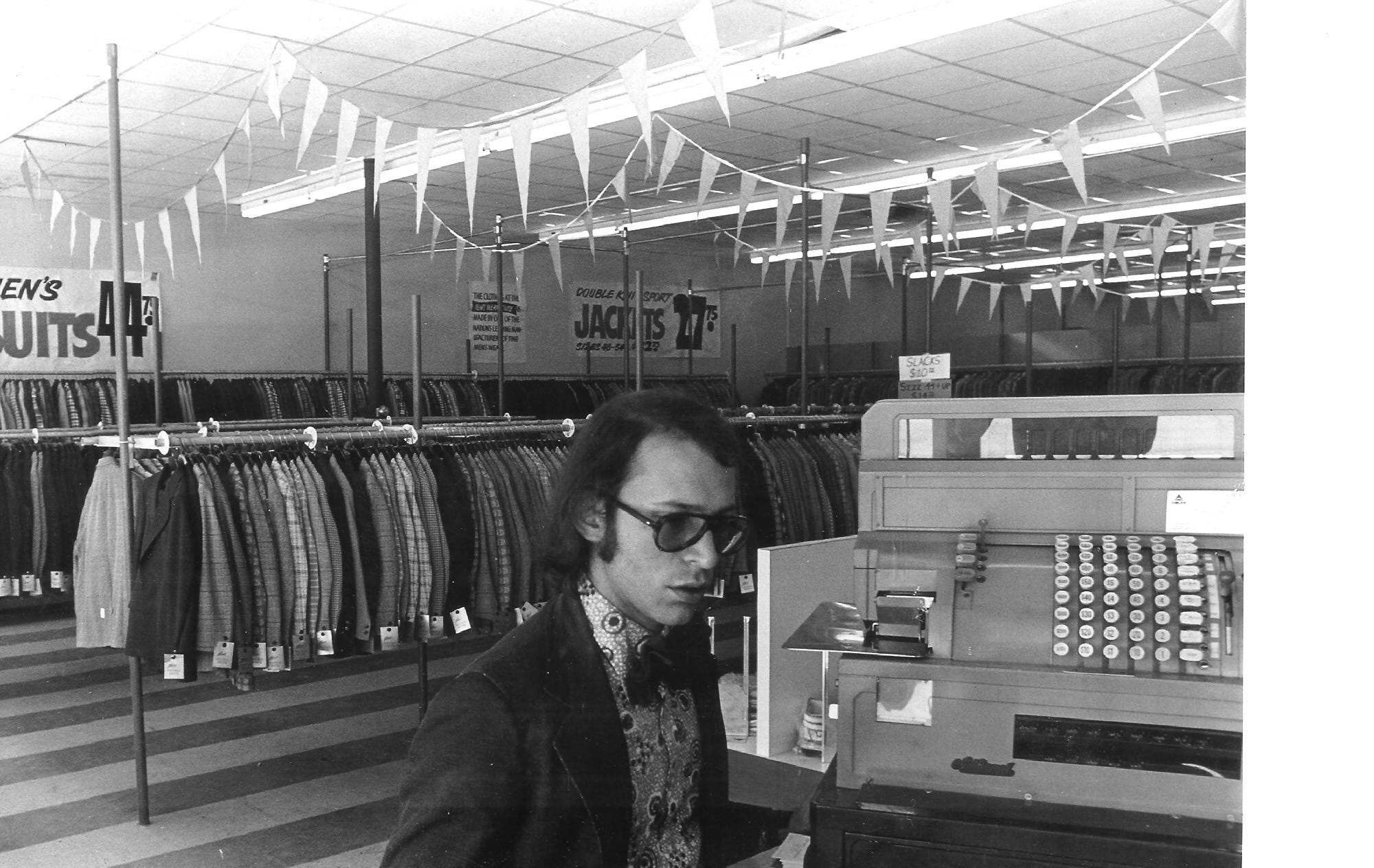
Business was slow most of the time except on Friday and Saturday, so there were usually just two of us in the store at any one time, and I had the opportunity to get to know both David and Harry very well.
After a few months, George began to talk about opening a second MW location, and possibly a third.
One day, he approached the three of us and asked if we were interested in becoming equity partners with him. Seemed interesting, but within a few days of George’s offer, I got the offer I had been pining for–Marcom-Day was ready to hire me.
This was going to be a tough call—either a flyer at a company that was only a few months old and losing money, or my dream job—the reason I moved halfway across the country.
My decision was made easier soon enough.
David wasn’t interested in making a career of MW, and he said no. Harry wanted in, and he accepted. Much to George’s shock and dismay, I also said no, and I had to have a difficult conversation with him about why. I told him about the offer from Marcom-Day, which came as no surprise. But I also had to be honest with him, noting that while I honored and respected the loyalty to his college friend, I didn’t really think Harry’s background in computers was something one MW store needed. What the store needed was someone on the floor day after day selling clothing–something Harry was loath to do.
Since MW would be one of my accounts while at Marcom-Day, I assured George he’d be seeing plenty of me, and I would take special care of the MW business.
We also agreed to keep the door open should circumstances change.
I was finally off to realize my advertising dream and finally have that elusive “e” word. Experience……
Which turned out to be one of the best decisions I ever made.
Until it wasn’t……….
STAY TUNED FOR THE FURTHER ADVENTURES OF DICKIE THE DREAMER, or HOW TO LAND FLAT ON YOUR FACE AND STILL BE ABLE TO STAND UP.
* (For those 21st-century folk): Big yellow book, good for finding businesses and even better as a booster seat.
** The closest I could get to air-conditioning was driving 55 mph with four windows open.
Want more Curmudg between Wednesdays?
Check out Notes—random musings, timely observations, and the occasional revisit of an older column that still feels uncomfortably relevant.
wow!! a 55.4….
i lived in Phoenix with a 60.2 and no aircon. alA three speed with a chrome shifter in the column. Still have scars from that car.
Question what model Citroen did for have, I had a 68 DS 21 a French model with fog lamp that moved with the steering wheel.